Introduction to RPent#
RPent (Recursive Physical Agent) is an open framework for building embodied agents that continuously evolve through recursive interaction with the physical world. Rather than prescribing a single foundation model, RPent provides a recursive agent framework that harnesses heterogeneous intelligence, including perception, reasoning, memory, execution, and self-evolution, into a unified physical agent. Through continuous interaction, reflection, and adaptation, RPent enables physical agents to acquire new capabilities and evolve beyond their initial design.
The name Pent is inspired by the Pentagram, whose five points symbolize the integration of multimodal intelligence into a unified embodied agent. At its center, the infinity symbol (∞) represents the endless recursive cycle of perception, reasoning, execution, and self-evolution, through which intelligence continuously expands into the physical world.
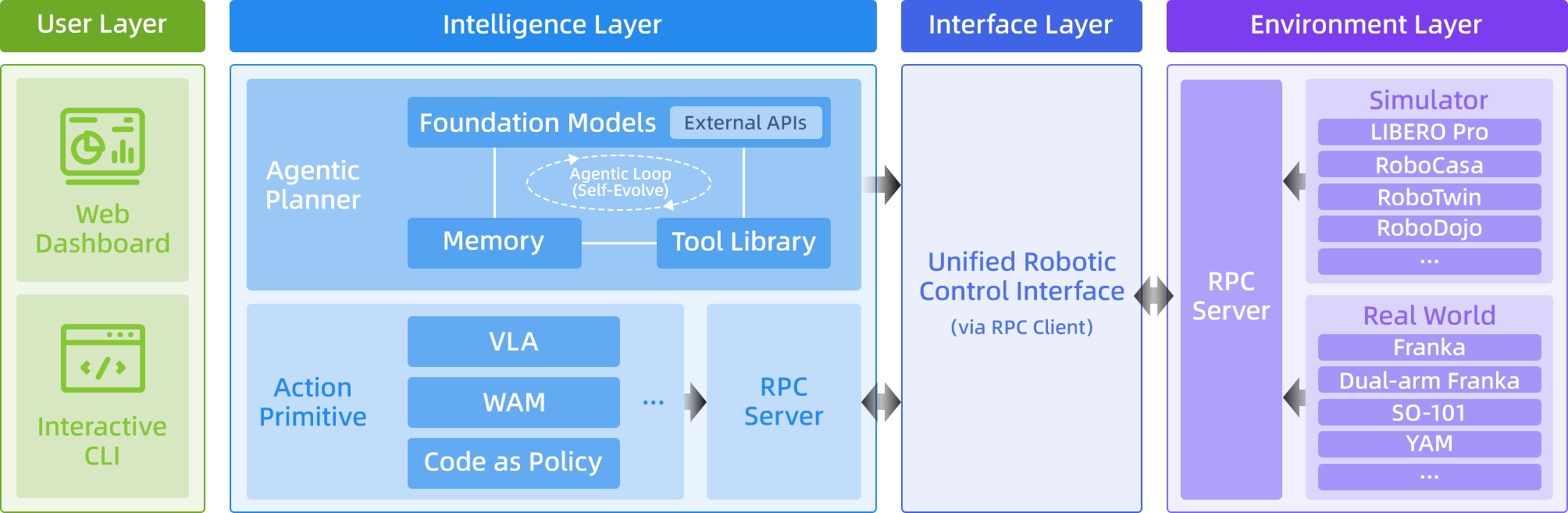
RPent is built upon three core design principles: service-oriented, standardized, and composable. RPent enables capabilities to be deployed as reusable services, connected through unified interfaces, and flexibly composed into diverse physical agents. Together, these principles allow RPent to move beyond traditional robot control frameworks and establish an agentic infrastructure for the physical world, where intelligence is not only deployed, but continuously built, expanded, and evolved.
Leaderboard#
Compare success rates on LIBERO, LIBERO-PRO, RoboCasa365 Target50, and RoboTwin C2R. Rankings apply to the methods and evaluation coverage shown; see RPent Leaderboard for detailed results, configurations, and sources.


Choose a Platform#
Platform |
Documentation |
|---|---|
Pi0.5, SAM3, and LIBERO / LIBERO-PRO runs and reproduction. |
|
RLDX-1, kitchen tasks, and Target50 reproduction. |
|
LingBot-VLA, dual-arm simulation tasks, and C2R reproduction. |
|
Dual-arm ARX-X5 manipulation in Isaac Sim, with the RLinf Pi0.5 policy. |
|
Hardware preparation, calibration, motion checks, and operation. |
|
Two-node deployment, operation, and exploration with an operator. |
|
Task demo available; installation and usage documentation is coming soon. |
|
Coming soon. |
Choose api, claude_code, or codex for online planning. LIBERO also supports Flash Mode for executing stored plans. See Planner Configuration for model-service configuration.
Start with Quick Start. See RPent Leaderboard for reported results and resource costs, and Harness VLA for the research background.
DreamZero, Cosmos Policy, and RoboDojo are also listed in the project roadmap; their usage documentation is pending.